Two Pools Instead of One — What Year-Round Swimming Actually Requires
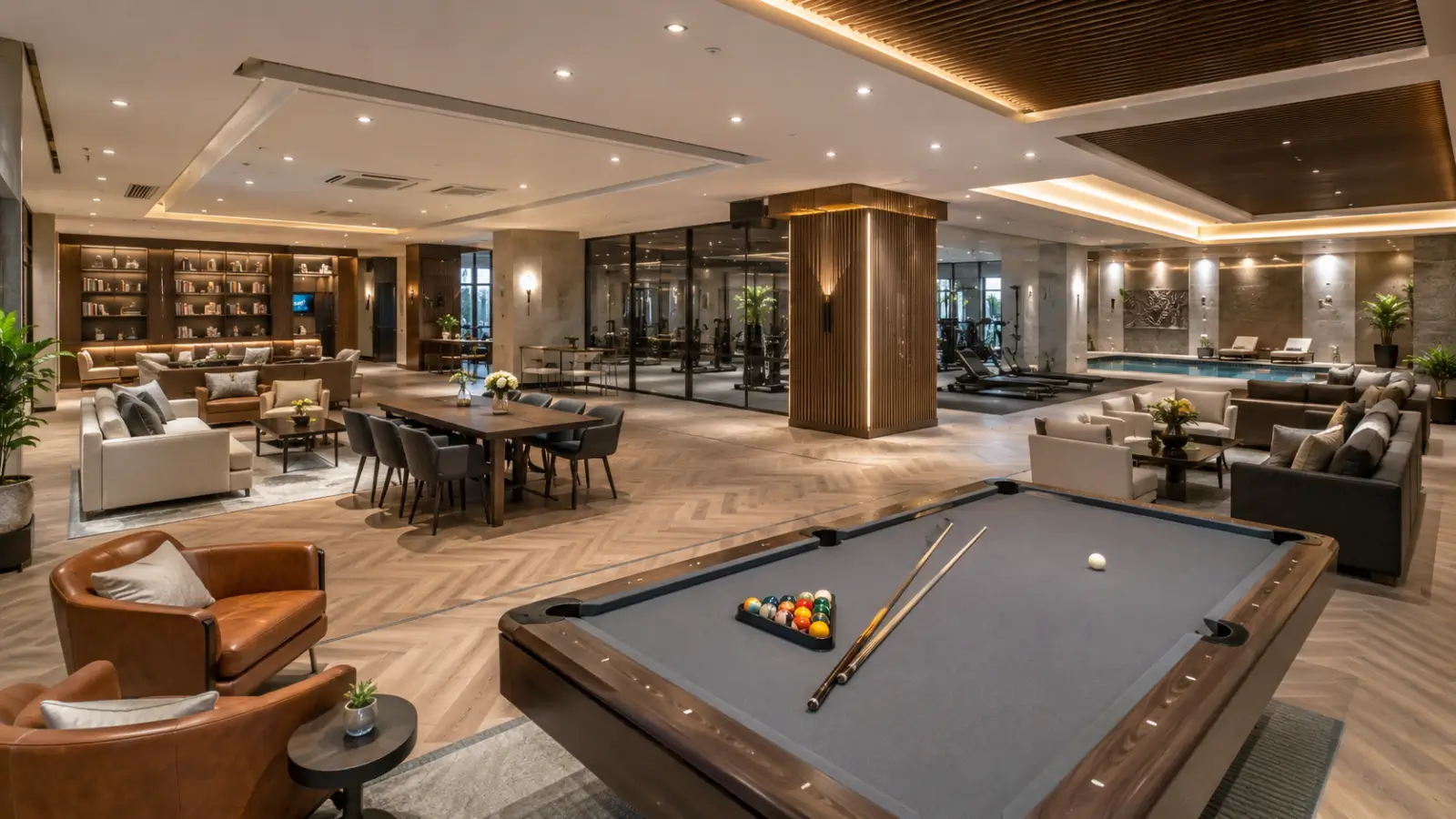
Bangalore's monsoon removes an outdoor pool from practical use for months at a time, which is why an indoor heated pool is a functional provision rather...
Bangalore's monsoon removes an outdoor pool from practical use for weeks at a stretch, and the cooler months reduce it further for anyone swimming early or late. An indoor heated pool is therefore a functional provision rather than a luxury duplicate. Embassy Riverine carries both: a heated indoor pool inside the 40,000 sft clubhouse and an outdoor pool set to overlook the 19-acre landscape spine.
What the pairing buys is consistency of habit. A swimmer who trains three mornings a week needs the facility available in July as much as in February, and a single outdoor pool converts that routine into a seasonal one. Households that swim for rehabilitation or joint conditions feel the interruption more sharply still, because the alternative exercise is often unavailable to them. Any household where swimming is part of a health routine rather than a weekend activity should treat this as a specification item, not an amenity flourish.
Placement of the outdoor pool matters alongside its existence. Overlooking the landscape spine rather than backing onto a boundary wall or a car park determines whether it functions as somewhere to spend an afternoon or merely somewhere to swim lengths. A children's afternoon by the pool works when there is shade, lawn and sightlines nearby, and the spine provides all three with shaded cabanas, viewing decks and open lawn distributed along it.
The indoor pool's clubhouse setting brings the adjacent provision into use as well. A spa wing with steam and sauna sits in the same wellness zone, alongside a gymnasium with personal-training capacity and a yoga and meditation pavilion kept separate from the equipment floor. Separation there is deliberate: a yoga room adjoining a weights area serves neither well, and the two are commonly combined in enclaves trying to inflate a feature count.
Operating cost is the honest counterweight and it belongs in the discussion. Heating an indoor pool is a continuing expense borne through the maintenance charge, and it is one of the reasons villa-enclave charges deserve scrutiny before booking. A solar-based hot water system serves the villas here, and township-level infrastructure absorbs part of the load, but a heated pool is not free to run and nobody should pretend otherwise.
Two things worth confirming. Ask whether the indoor pool is heated year-round or seasonally, since the distinction is often left ambiguous and it determines whether the provision does what it appears to. Then confirm both pools sit on reserved open space within the sanctioned plan rather than on land that could be released later, which becomes verifiable once Karnataka RERA registration completes.
Related reading: the Embassy Riverine amenities guide.
FAQs
Does Embassy Riverine have both indoor and outdoor pools?
Yes. A heated indoor pool sits inside the 40,000 sft clubhouse and an outdoor pool overlooks the 19-acre landscape spine, so swimming stays available through the monsoon and the cooler months.Why does an indoor pool matter in Bangalore?
The monsoon removes an outdoor pool from practical use for weeks at a stretch and cooler months reduce early or late swimming further. Households where swimming is part of a health or rehabilitation routine feel that interruption most.What is the cost implication of a heated pool?
Heating is a continuing expense carried through the maintenance charge. It is one reason to review how villa-enclave charges are separated from apartment-parcel charges before booking, and to confirm whether heating runs year-round or seasonally.
Related Articles
Embassy Riverine Villas vs MAIA The Seven: Which Bengaluru Suits You?
Embassy Riverine Villas vs MAIA The Seven: compare North and South Bengaluru luxury homes on location, size, price, density, approvals and possession.
Embassy Riverine Villas vs Century Immencity: Villa Land or Vertical Living?
Compare Embassy Riverine Villas vs Century Immencity on price, density, size, location, airport access, RERA status and possession.
Embassy Riverine Villas vs MAIA Mansion: Villa Enclave or Bespoke Mansion?
Embassy Riverine Villas vs MAIA Mansion: compare two North Bengaluru luxury communities on scale, density, home sizes, pricing, customisation and documentation.
Embassy Riverine Villas vs Embassy Greenshore: Villa Enclave or Lakefront Tower?
Embassy Riverine Villas vs Embassy Greenshore: compare two Embassy township projects on villa versus apartment living, pricing, density, location, RERA and possession.